
Training dummies are probably the most misunderstood piece of dog training equipment available. Most people assume they're exclusively for working gundogs — the territory of serious field trial competitors and professional handlers. In reality, they're one of the most versatile and useful training tools available, and a significant number of pet dogs with retrieving instincts would benefit enormously from them.
This guide explains what dog training dummies are, where they come from, which dogs are best suited to them, how to introduce one for the first time, and three foundation exercises any owner can start with regardless of background.
What Is a Training Dummy? Origins in Gundog Work
A training dummy — also called a retrieval dummy or field dummy — is a shaped, weighted object designed to be thrown, carried, and retrieved. Its origins are in gundog training, where they serve as a safe substitute for game during the foundational stages of training.
Working retrievers — Labradors, Golden Retrievers, Spaniels, and HPR (Hunt-Point-Retrieve) breeds — need to learn to hold, carry, and deliver objects to hand. Dummies allow handlers to teach and practise these behaviours without using real game, with the obvious practical advantages of availability, cleanliness, and the ability to train year-round across Ireland regardless of season. What makes them useful beyond gundog work is the same property that makes them useful within it: they engage a dog's natural retrieve and carry drive in a structured way.
Types of Dog Training Dummies
Canvas Dummies
The standard working dog dummy. Firm but not hard, sized in 250g, 500g, and 1kg versions. Canvas provides a texture that most dogs grip naturally, and the material absorbs and holds scent well — which is important for both motivation and scent discrimination exercises. The Firedog Standard Dummy with Rabbit Fur is an example of this type, with the addition of a fur trim that increases motivation for retrieving breeds.
Snack Dummies
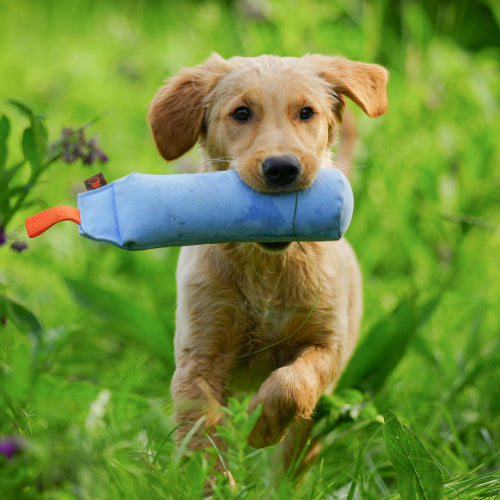
A specific type designed with a compartment that holds food. The Firedog Snack Dummy with Fur Ring is designed so that the reward comes from the dummy itself — the dog retrieves and presents the dummy to receive a treat from inside it. This is particularly effective for building retrieve motivation in dogs that are food-driven but initially not particularly interested in the act of carrying an object.
Rubber and Float Dummies
More durable than canvas and suitable for water work and harder use. Rubber dummies float, making them useful for water retrieves in rivers, lakes, and along the Irish coast. The firmer feel suits some dogs better than canvas, particularly those that tend to grip hard.
Which Breeds Benefit Most From Training Dummies
- Labradors and Golden Retrievers: the archetypes. Strong retrieve drive, soft mouth, and natural delivery to hand make them the ideal candidates.
- Spaniels (Cocker, Springer, Working Cocker): hunting flush-and-retrieve dogs. Dummy work channels the natural urge to find and carry into structured, productive exercise.
- HPR breeds (Hungarian Vizsla, German Shorthaired Pointer, Weimaraner): all-round hunting dogs with strong retrieve drive once stimulated through the right introduction.
- Border Collies: not natural retrievers, but highly trainable and many take to dummies enthusiastically once drive is established through food-loaded snack dummies.
- German Shepherds: dummy work can build drive and focus in a structured way, channelling high-energy dogs into purposeful activity.
The key question for any individual dog is whether they show carry drive — any interest in picking up and holding objects. If a dog naturally picks up and carries toys, sticks, or other items, they're a candidate for dummy work.
Can Any Dog Use a Training Dummy? The Drive Question
Drive is the deciding factor. A dog with natural carry drive will take to training dummies quickly. A dog with no carry interest can sometimes have it developed, but it requires patience and the right starting point. For dogs with low retrieve interest, a snack dummy is always the better starting point — the food reward built into the dummy gives the dog a reason to engage with the object and return with it, before the retrieve behaviour itself has been reinforced as inherently rewarding.
Never force a dog to hold or carry. A dog that is uncomfortable holding an object in their mouth will not develop a reliable retrieve and may develop negative associations with training sessions that are difficult to undo later.
Introducing a Dummy to Your Dog for the First Time
- Let the dog investigate without pressure. Place it on the ground and allow them to sniff, nose, and interact with it on their own terms. Don't put it in their mouth or encourage retrieval on the first contact.
- Once the dog shows comfortable interest, introduce movement — roll it, toss it a short distance. Any interaction (nosing, picking up, carrying even briefly) is rewarded enthusiastically.
- Do not chase the dog if they pick up the dummy and carry it away. This creates a keep-away game that undermines delivery to hand. Turn away and move in the opposite direction — most dogs will follow.
- Keep first sessions short: 5–10 minutes maximum. End on a positive interaction, before the dog loses interest.
Three Foundation Exercises to Start With
Exercise 1: The Marked Retrieve
The basic building block of all retrieve work. Throw the dummy a short distance with the dog watching — this is the 'mark'. Send the dog immediately with a release cue. When they pick up the dummy, turn and move away to encourage the return. Reward enthusiastically on delivery. Start with very short distances — 3–5 metres — and build gradually as reliability and confidence increases.
Exercise 2: The Blind Retrieve
The dog doesn't see where the dummy lands and must be directed to it by the handler. This exercise builds responsiveness to handler signals, increases attention and focus, and develops the problem-solving aspect of retrieve work that many retrieving breed owners find so engaging. Initially, simply hide the dummy while the dog is not watching and then send them. As skill develops, introduce directional signals — a raised arm to indicate direction.
Exercise 3: Hold and Present
Before the full retrieve, teach a clean hold and present independently. Hold the dummy in front of the dog, reward any contact or grip, and gradually build to the dog holding the dummy comfortably while sitting in front of you before releasing on a 'give' or 'dead' command. A clean, calm delivery to hand is the finish of the retrieve and often the hardest part to train well. Developing it as a separate exercise prevents the grabbing, dropping, and excited circling that often develops when the full retrieve is trained without attention to the delivery component.
Dummy Care, Storage, and the Dummy Bag
Canvas dummies absorb moisture, scent, and soil during use. After each session, allow dummies to air dry fully before storage. Store in a cool, dry place away from direct sunlight, which degrades canvas and rubber over time.
A dummy bag — a ventilated carry bag designed for training dummies — keeps your kit organised, protects dummies from damage during transport, and prevents the scent from contaminating other equipment or your vehicle. If you're doing regular dummy work with multiple dummies of different weights, a dedicated bag is practical rather than optional.
Frequently Asked Questions
What is a dog training dummy used for?
Training dummies are used to teach and practise retrieve behaviours — picking up, carrying, and delivering an object to hand. They originate in gundog training but are useful for any dog with carry drive. Exercises range from simple marked retrieves to complex blind retrieves with directional signals, providing structured mental and physical stimulation.
Can any dog use a training dummy?
Most dogs with some natural carry interest can learn to use a training dummy. Dogs with strong retrieve drive (Labradors, Spaniels, HPRs) take to them immediately. For dogs with lower drive, a snack dummy that holds treats inside provides a food-motivated entry point that builds the retrieve habit over time.
What size dummy should I buy?
Match dummy weight to dog size and carrying ability. 250g for small breeds and young dogs; 500g for medium breeds including working Labradors and Springer Spaniels; 1kg for larger dogs or advanced work. When in doubt, start smaller — the dog should be able to hold and carry the dummy with a natural, comfortable grip.
Where can I buy dog training dummies in Ireland?
Dogs Shop Ireland stocks Firedog training dummies and dummy bags with nationwide delivery to dog owners in Dublin, Cork, Galway, Limerick, Waterford, Kilkenny, Sligo, Drogheda, Naas, Navan, Ennis, Tralee and all of Ireland. Based in Rathangan, Co. Kildare. Visit dogs-shop.ie.
Do I need a dummy bag?
For regular sessions with multiple dummies, a dedicated dummy bag keeps kit organised and protects dummies from damage during transport. It also keeps dummy scent concentrated, which matters if you're working dogs on scent discrimination exercises alongside basic retrieve work.
Scientific References
[1] Reid, P.J. (1996) — 'Excel-Erated Learning: Explaining in Plain English How Dogs Learn and How Best to Teach Them.' James & Kenneth Publishers, California. Foundational text on operant conditioning applied to retrieve training.
[2] Serpell, J. (ed.) (2017) — 'The Domestic Dog: Its Evolution, Behaviour and Interactions with People.' 2nd ed. Cambridge University Press. Chapter on breed-specific behaviours and working dog drives.
[3] Coppinger, R. & Coppinger, L. (2001) — 'Dogs: A Startling New Understanding of Canine Origin, Behaviour and Evolution.' Scribner, New York. Analysis of breed motor patterns including retrieve behaviours in working breeds.