
Treats are one of the leading causes of weight gain in dogs — not because treats are inherently harmful, but because most owners genuinely don't track them. A few training rewards here, a dental chew there, a small piece of something at the worktop, and the calories add up invisibly while the main meal stays exactly the same. This guide covers how to think practically about dog treat portions, what the 10% rule actually means in real numbers, and how different treat types compare on calories.
The good news: choosing the right low-calorie dog treats for training gives you far more flexibility than most owners realise — without sacrificing the motivation quality that makes training work.
The Invisible Calorie Problem
Research into canine obesity consistently identifies treat overfeeding as a significant contributing factor. Unlike meals — which are typically measured and consistent — treats are given ad hoc, often without reference to the dog's overall daily intake.
In a 10kg dog with a daily calorie requirement of 350–400 kcal, a piece of cheese, a dental stick, and 30 small training treats together could account for 100–130 kcal — between 25% and 35% of the daily energy budget — before the main meal is counted. The treats feel inconsequential in the moment. In aggregate, they're not.
Association for Pet Obesity Prevention (2022)
Annual survey data consistently identifies treat overfeeding as one of the three primary drivers of canine overweight and obesity, alongside excessive main meal portions and insufficient exercise. Owners surveyed significantly underestimated the caloric contribution of treats, often by 50% or more.
The 10% Rule Explained — and When It's Too Simplistic
The 10% rule for dog treats states that treats should account for no more than 10% of a dog's total daily caloric intake. For a 10kg dog requiring 400 kcal per day, 10% is 40 kcal in treats. For a 30kg Labrador requiring 1,100 kcal per day, 10% is 110 kcal. These numbers put the treat budget in real terms.
The rule has limits, though. It assumes the remaining 90% from main meals is correctly calibrated — but many dogs are already slightly overfed at meals, meaning 10% in treats pushes them into surplus. It also doesn't account for treat type. 10% in cheese (high fat, high calorie) lands very differently than 10% in air-dried beef lung (very high protein, very low fat, much lower calorie per gram). The rule is most useful when combined with an understanding of what you're actually feeding.
How to Calculate Your Dog's Daily Calorie Allowance
The most accurate approach is a Resting Energy Requirement (RER) calculation, adjusted for activity level:
- Calculate RER: RER (kcal/day) = 70 × (body weight in kg)^0.75
- Multiply by an activity factor: 1.2–1.4 for neutered/sedentary adults; 1.6–2.0 for active dogs; 1.8–3.0 for working dogs
Example: a 20kg moderately active neutered dog. RER = 70 × (20)^0.75 = 662 kcal. Activity factor 1.4 = 927 kcal/day. 10% treat allowance = 93 kcal. Your vet can provide a daily calorie target tailored to your dog's individual condition score and metabolic rate.
Treat Calories Compared — How Different Treat Types Stack Up
High-Calorie Treats (use sparingly)
- Cheese: approximately 100–120 kcal per 25g. High in fat, high palatability, quickly consumed. Best reserved for very high-value reward moments in dog training — not everyday use.
- Commercial dental sticks: typically 60–80 kcal per stick. Often underestimated because they're marketed as a dental product rather than a food.
- Cooked meat pieces (chicken breast, etc.): approximately 30–50 kcal per 25g. Clean protein but add up quickly in high-volume training sessions.
Moderate-Calorie Treats
- Air-dried turkey chunks: approximately 25–35 kcal per 10g. Good protein, moderate calorie load. Practical for dog training sessions of moderate length without adjusting meals.
- Fish treats (tuna, cod): approximately 25–30 kcal per 10g. Very high palatability for the calorie cost. Excellent dog training treats with a strong motivating aroma.
Low-Calorie Dog Treats (most flexibility)
- Air-dried beef lung / Beef Puffs: approximately 8–12 kcal per 10g. Very high protein, extremely low fat. Generous session use without concern — ideal for high-repetition dog training.
- Lamb and pork lung: similar profile to beef lung — the best low-calorie training treats for high-volume sessions.
- Air-dried beetroot: very low calorie, primarily fibre and micronutrients. Can be used as a meal supplement without meaningfully impacting daily totals.
Adjusting Meal Size on Heavy Training Days
The most practical approach to managing treat calories is to adjust the main meal on days when treat use is higher than usual. If you're running a 45-minute dog training session and rewarding frequently, estimate the treat total and subtract it from the evening meal.
Working dog handlers and competitive trainers do this routinely. On heavy training days, meals are smaller. On rest days, meals are full. This approach keeps the dog's overall intake stable and prevents the slow calorie creep that leads to weight gain over months — the kind that creeps up without any single meal or session being the obvious culprit.
Low-Calorie Treat Options for Dogs on a Diet
If your vet has recommended weight loss for your dog, treat selection matters significantly. The goal is to maintain training quality and frequency — which requires adequate reward value — while keeping calorie contribution minimal.
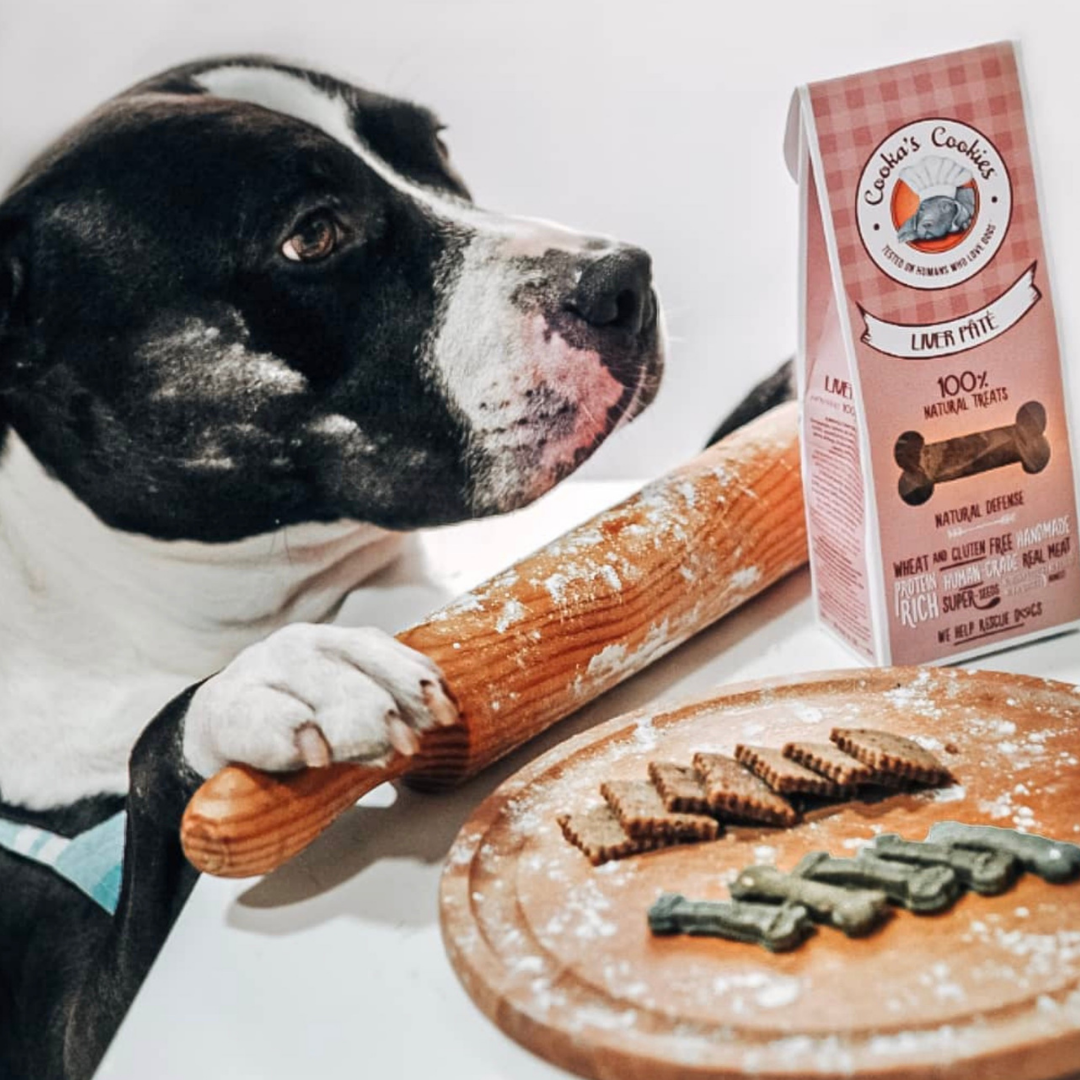
Cooka's Cookies Beef Puffs (€5.20) — air-dried beef lung, 69% protein, just 1.4% fat — are the most practical solution. Their combination of very high protein, very low fat, and low calorie density means you can reward generously without compromising a calorie deficit. The strong aroma means you don't need larger pieces to get the same motivational effect. For a mid-value everyday training treat, Loype Air-Dried Turkey Chunks (€4.50) sit in the moderate range and suit most daily treat budgets without adjustment.
Signs You're Overfeeding Treats
- Gradual weight gain despite no change in meals — treat creep is usually the culprit
- Your dog is rarely hungry at mealtimes, consistently leaving food or showing disinterest
- Your dog demands treats frequently and shows frustration when they're not forthcoming — treats have become an expectation rather than a reward
- Loose stools on days after heavy treat use — a sign the total protein or fat load exceeded digestive capacity
Frequently Asked Questions
How many treats should a dog have per day?
There's no single number — it depends entirely on the treat type and your dog's daily calorie allowance. The 10% rule is a useful guide: treats should account for no more than 10% of total daily calories. For a 20kg active dog needing around 900 kcal per day, that's 90 kcal in treats — which could be 2–3 pieces of cheese or over 100 small pieces of air-dried beef lung. The treat type determines the volume you can give, not the other way around.
Can treats cause weight gain in dogs?
Yes — and it's one of the most common causes of gradual weight gain in dogs because treats are rarely tracked alongside meals. The calories are real regardless of the size of the piece. Switching to lower-calorie natural dog treats and adjusting meals on heavy treat days prevents accumulation without reducing training frequency or quality.
Are natural treats lower in calories than commercial ones?
Not necessarily — it depends on the specific product. High-protein, low-fat natural treats like beef lung are genuinely very low in calories. Other natural treats like cheese or fatty meat can be high. The key is to check the crude fat percentage on the label — fat is the most calorie-dense macronutrient and is the primary driver of calorie density in dog treats.
Should I reduce meals on days when I give a lot of treats?
Yes — this is the most practical way to maintain a stable daily calorie intake during intensive dog training. Estimate the treat contribution during the day and reduce the evening meal by roughly that amount. You don't need precision, just awareness. Over time, this becomes intuitive and prevents the gradual weight gain that comes from treating liberally without adjusting meals.
Where can I buy low-calorie dog treats in Ireland?
Dogs Shop Ireland stocks low-calorie natural dog treats including beef puffs, lung treats, and turkey chunks with nationwide delivery to dog owners in Dublin, Cork, Galway, Limerick, Waterford, Kilkenny, Sligo, Drogheda, Naas, Navan, Ennis, Tralee and all of Ireland. Based in Rathangan, Co. Kildare. Visit dogs-shop.ie.
Scientific References
[1] Larsen, J.A. & Villaverde, C. (2016) — 'Scope of the problem and perception by owners and veterinarians.' Veterinary Clinics of North America: Small Animal Practice, 46(5), 761–772.
[2] German, A.J. (2006) — 'The growing problem of obesity in dogs and cats.' Journal of Nutrition, 136(7), 1940S–1946S.
[3] Laflamme, D.P. (2012) — 'Companion animals symposium: obesity in dogs and cats: what is wrong with being fat?' Journal of Animal Science, 90(5), 1653–1662.