
Watch a good agility handler, a gundog trainer, or a protection sports competitor reward their dog, and you'll rarely see a treat. You'll see a toy come out, and the dog explode into a game of tug like nothing else in the world matters. That's not a quirky preference. Dog tug toys tap into a reward system that food can't reach, and once you understand why, you'll use them very differently.
Why Tug Works as a Training Reward
A reward only has one job: make the dog want to repeat what just earned it. Food does that job well, most of the time. Tug does something food can't. It builds arousal.
When a dog grabs, pulls, and shakes a toy, they're running a predatory motor sequence. It releases adrenaline. It releases endorphins. And it leaves the dog sitting at a higher baseline of drive for whatever comes next. That's why handlers of high-drive dogs — Malinois, Border Collies, working-line German Shepherds — lean on tug so heavily. These dogs need a reward that matches their engine, and a biscuit just doesn't.
What Tug Teaches That Treats Don't
It Builds Real Impulse Control
A properly run tug game has rules. The dog takes the toy on invitation. Holds until released. Drops on cue. That's impulse control, hidden inside a game the dog loves. Dogs that learn this structure tend to carry the self-control into other parts of life, not just the game itself.
It Builds Handler Connection
Tug needs two players. You're the one who produces the toy, runs the game, and decides when it starts and stops. That puts you at the centre of the reward in a way food rarely does — a dog chasing a treat is often focused on the treat, not on you.
It Trains Arousal Control
A dog that plays tug well learns to go from full drive to calm focus and back again, on your terms. That skill matters anywhere a dog needs to perform under pressure: competition rings, busy trails, a vet's waiting room.
Three Tug Myths Worth Clearing Up
"Tug makes dogs aggressive." It doesn't. There's no solid behavioural evidence linking structured tug play to aggression. Some dogs that play tug also have aggression issues elsewhere, but one doesn't cause the other. What actually causes trouble is a tug game with no rules at all — no invitation, no drop cue, no structure. Add the structure back, and the risk goes with it.
"You should never let your dog win." You can. Letting your dog finish a session holding the toy doesn't damage your authority — it often makes them keener for the next game. The part that matters is the drop cue. If your dog releases the toy reliably when you ask, letting them "win" in between is just fine.
"Tug is only for working dogs." Not true. Most dogs can learn structured tug play if you introduce it well. Owners often assume their dog "isn't toy motivated" when really, no one's shown that dog how the game works yet.
Introducing Tug to a Dog That Won't Play
Some dogs need a proper introduction before tug clicks for them. Here's a simple path in:
- Get the toy moving. A toy lying still is boring. Drag it, flick it, bounce it along the ground so it behaves like prey. That's what flips the switch.
- Reward tiny wins. A nose-touch, a mouth on the toy, a half-hearted grab — praise it, play it up, make it feel like a big deal.
- Make the toy rare. Bring it out, play, and put it straight away again. A toy that's always lying around loses its pull fast.
- Time it around meals. A dog that's been moving and is getting hungry is already a little more switched on. Use that window.
Using a Tug Toy as a Training Reward
Before tug earns a place in your training toolkit, your dog needs one thing locked in: a reliable drop on a single cue. Train "drop" or "out" on its own first. Only fold it into tug once it holds up under distraction. Grabbing the toy without an invitation shouldn't start the game — it should make the toy vanish.
Keep the actual reward short. Ten to thirty seconds of real engagement beats five minutes of play every time, because a short burst lifts drive without tipping the dog into a state where they can't refocus. Save it for the moments that earn it: a recall nailed in a hard environment, a new skill clicking for the first time, real precision at a harder level than before.
Choosing the Right Dog Tug Toy
Not every toy on the floor at home works as a training tool. Tug-E-Nuff builds toys specifically for this job, and the range breaks down like this:
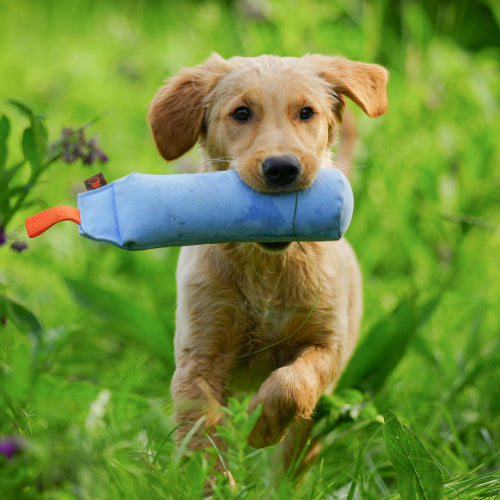
- Bungee tug toys — the elastic core soaks up some of the force on every pull, which is easier on your arm and on your dog's neck and spine over a long session. Popular with sport dog handlers across Ireland and the UK.
- Fleece tug toys — softer in the mouth, a good starting point for sensitive dogs or puppies just learning the game.
- Ring tug toys — a wider grip surface, well suited to dogs that like to shake the toy during play.
Get the size right. Too small, and your dog can't get a proper grip. Too large, and holding it comfortably becomes the problem instead of the game. Browse the full dog tug toys range at Dogs Shop to find the right size and style, and check out the wider dog training gear collection if you're building out a full reward toolkit alongside it.
FAQ
Does tug play make dogs aggressive?
No. This is a persistent myth with no real evidence behind it. Structured tug — take on invitation, drop on cue — builds impulse control and handler connection instead. Badly managed play of any kind can encourage pushiness, but the fix is structure, not avoiding tug altogether.
Should I let my dog win at tug?
Yes, generally. Letting your dog end a session holding the toy tends to boost their motivation for next time. What actually matters is the drop cue holding up on request.
My dog doesn't play with toys. Will tug ever work?
Usually, yes. Toy drive can be built in most dogs with the right introduction — movement to trigger interest, scarcity to keep it exciting, and enthusiastic reward for every small step toward engaging.
What's the best tug toy for dog training?
A purpose-built option, like the range from Tug-E-Nuff, generally beats a household toy. They're sized properly, built to hold up to real engagement, and often include a bungee element that softens the impact of repeated sessions.
Where can I buy dog tug toys in Ireland?
Tug-E-Nuff tug toys are available through Dogs Shop, based in Rathangan, Co. Kildare, with delivery across Ireland including Dublin, Cork, Galway, Limerick, Waterford, Kilkenny, Sligo, and beyond.
If your dog already loves a game of tug, you've got a training reward most handlers would kill for — browse the full tug toy range here and put it to work in your next session.