
What Makes a Quality Natural Dog Treat? The Science Behind the Label
Share
Walk into any pet shop in Ireland and you'll be confronted with dozens of dog treat options, all promising something. 'Natural'. 'Healthy'. 'Premium'. 'Grain-free'. The language is familiar, but without knowing what's actually inside — and what the science says about those ingredients — it can be genuinely hard to tell a quality treat from a well-marketed one.
This guide explains, with reference to published research, what separates a genuinely good natural dog treat from one that's simply labelled that way. It covers the ingredients that matter, the ones to avoid, the processing methods that affect nutritional quality, and how the three brands we carry at Dogs-Shop.ie — Loype, Cooka's Cookies, and Mr. Bones — approach each of these standards.
Why Treat Quality Matters More Than Most Owners Realize
Treats are often treated as an afterthought — a reward, a distraction, a bribe. But research published in Frontiers in Animal Science (2024) found that 92% of dog owners buy treats regularly, and most dogs receive them multiple times per day. At that frequency, treats are a meaningful contributor to daily calorie intake, micronutrient exposure, and cumulative chemical load.
Frontiers in Animal Science (2024)
A peer-reviewed review found that 92% of dog owners purchase treats regularly, and identified significant variation in nutrient density, sugar content, and labelling transparency across treat categories. The study noted that 'labelling should include more information on the ingredients used, and the varying nutrient and caloric density of treats should be considered.'
Source: Laflamme et al. — 'The science of snacks: a review of dog treats', Frontiers in Animal Science, 2024. [1]
A separate study published in PubMed (2018) analyzed 41 commercially available dog treats and found simple sugars in the majority of products, with most treats using non-specific ingredient categories rather than named sources — making it genuinely difficult for owners to assess what their dog was actually consuming. The practical implication: the treats you choose have a real impact on your dog's health over time. Once you know what to look for, the distinction between a genuinely natural dog treat and a processed one becomes much easier to make.
What Makes a Natural Dog Treat Genuinely Natural?
The word 'natural' has no legal definition in the Irish or EU pet food market. Any brand can use it. What it means in practice depends entirely on what's in the product — so the ingredient list is the only reliable guide.
1. Named protein as the first ingredient
The first ingredient is what the treat is primarily made from, by weight. In a genuine natural dog treat this should be a named animal protein: chicken, lamb, salmon, turkey, duck, rabbit, beef, pork, mackerel. Generic terms like 'meat and animal derivatives' are legally permitted but tell you almost nothing about the actual source or quality. For hypoallergenic dog treats specifically, named proteins are non-negotiable — a single-ingredient treat labelled '100% dried lamb lung' leaves nothing to interpretation.
2. Short, recognizable ingredient lists
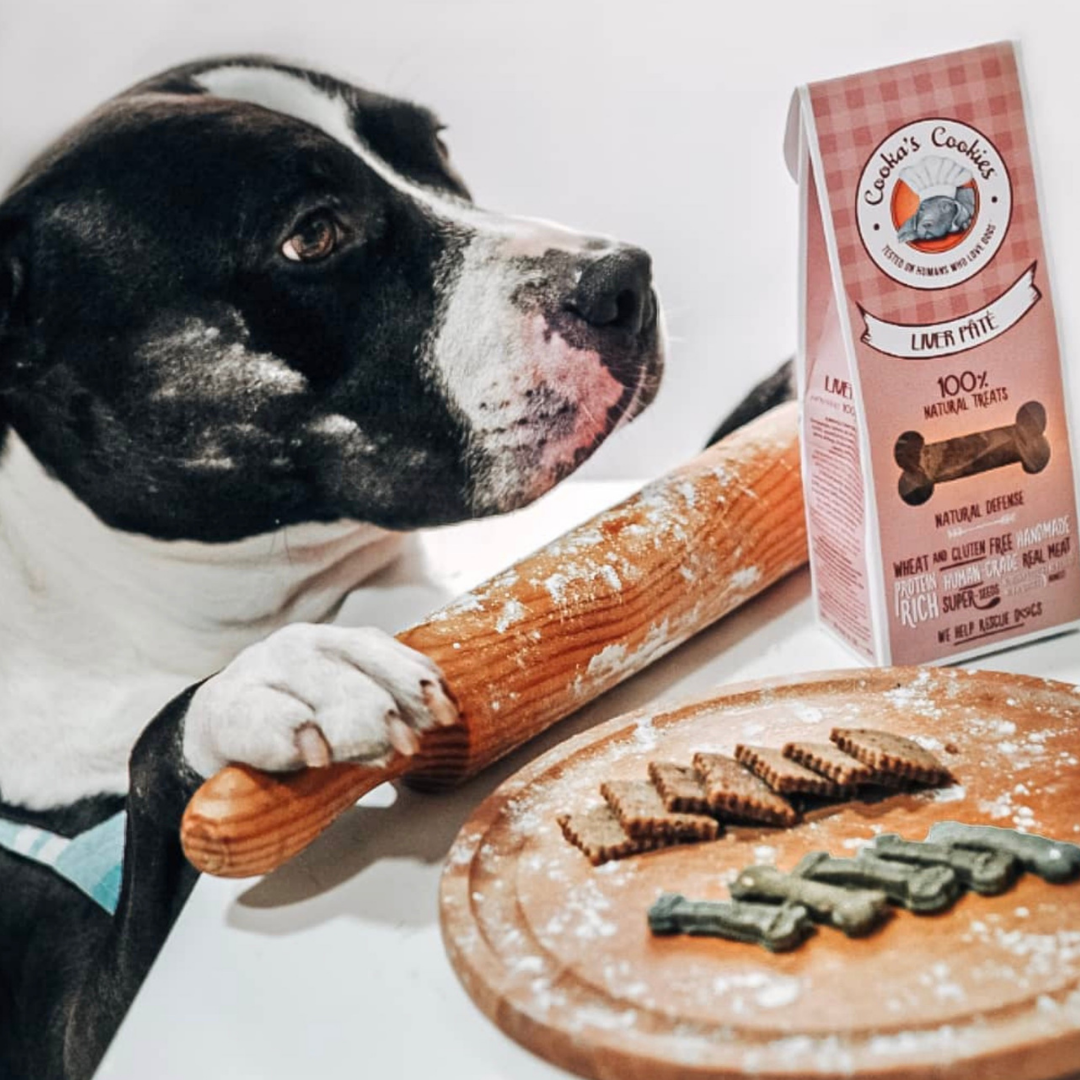
Count the ingredients. If you can't picture most of them as real food, that's informative. Cooka's Cookies Chicken Love biscuits list: chicken, carrot, flaxseed, rosemary extract, oregano. Every ingredient is a recognizable food. That's the standard a genuinely natural dog treat should meet. Single-ingredient air-dried treats — where the ingredient list is shorter than the product name — are the gold standard.
3. No artificial preservatives
The most commonly used artificial preservatives in processed dog treats are BHA (E320), BHT (E321), and ethoxyquin (E324). A 2021 review in the Journal of Small Animal Practice questioned the adequacy of safety testing for many pet food additives. The World Health Organization has classified both BHA and BHT as suspicious cancer-causing compounds; the EU has listed BHA as an endocrine disruptor; ethoxyquin is banned in Australian dog food and not approved in the EU. Quality natural treats preserve freshness through air-drying or through natural antioxidants like rosemary extract and vitamin E (tocopherols).
Journal of Small Animal Practice (2021)
A review examining the safety of additives in processed pet food noted that 'the adequacy of testing for many additives and the scientific basis for determining safety are questioned' and called for 'updated strategies and technologies' to establish safety in the pet food industry.
Source: Craig — 'Additives in pet food: are they safe?', Journal of Small Animal Practice, 2021. [2]
4. No added sugar, artificial colors, or flavor enhancers
Dogs have no nutritional requirement for sugar — it's added purely for palatability, and given that dogs are motivated by smell rather than taste, it serves more purpose for the manufacturer than the dog. Research has linked certain artificial dyes (including Ponceau Red 4R/E124) to increased anxious behavior in dogs. A genuinely natural dog treat requires no artificial flavor enhancers because real protein provides all the motivation a dog needs.
5. Grain-free where appropriate
Grain-free dog treats aren't necessary for every dog, but they're the right choice for those with grain sensitivities or digestive issues. Many lower-quality treats use wheat, corn, and soy as cheap bulking agents that add calories without nutritional value. All three brands at Dogs-Shop.ie produce grain-free treats across their ranges.
The Science of Processing: Why How a Treat Is Made Matters
Ingredients only tell part of the story. Processing temperatures dramatically affect what nutritional value reaches your dog. Conventional baked and extruded dog treats are typically manufactured at 150–200°C. Research published in the peer-reviewed journal Animals (2022) found that high-heat extrusion can destroy up to 40% of available nutrients, denatures proteins, and drives the Maillard reaction — forming advanced glycation end products (AGEs) associated in dogs with cataracts, osteoarthritis, and cognitive dysfunction.
Journal Animals / PMC (2022)
A peer-reviewed study examining nutrient retention across processing methods found that extrusion results in significant protein denaturation, lipid oxidation, and formation of AGEs. Elevated AGEs in dogs have been associated with cataracts, osteoarthritis, and cognitive dysfunction.
Source: 'The Hard Choice about Dry Pet Food: Comparison of Protein and Lipid Nutritional Qualities', Animals / PMC, 2022. [3]
Air-drying removes moisture at significantly lower temperatures, preserving proteins, enzymes, vitamins, and fatty acids in a form much closer to their natural state. It also eliminates the need for artificial preservatives — low moisture content prevents microbial growth through physical means rather than chemical ones. This is why single-ingredient air-dried treats like Loype's Mini Dogshmallows or Mr. Bones Duck Neck achieve a 12-month shelf life with nothing on the ingredient list except the protein itself.
A 2024 systematic review and meta-analysis published in PMC confirmed that minimally processed formats consistently preserved higher nutrient content than intensive processing methods, reinforcing that how a treat is made is as important as what it's made from.
The Three Brands at Dogs-Shop.ie — and Why They Qualify
Each brand at Dogs-Shop.ie has been selected for ingredient standards, manufacturing transparency, and alignment with what the research says a quality natural dog treat should be. Here's how each one approaches these standards — with a representative product from each.
Loype (origin: Czech Republic)
Loype's treat range is built entirely around air-dried single-protein pieces and soft training bites — all grain-free, all free from artificial preservatives. No unnecessary additions, no fillers. Loype's single-ingredient air-dried lamb lung is a 100% natural, grain-free, extremely low in fat — the cleanest training treat we stock for your dog:
Loype Mini Dogshmallows — 100% Dried Lamb Lung — From €4.50
Why it Qualifies?
One ingredient. Preserved entirely by air-drying. Analytical protein content: 70%+. No preservatives, no color, no sugar.
Cooka's Cookies (origin: Portugal)
Every Cooka's recipe is developed with veterinary input, produced in bakeries certified for human food production, and preserved with rosemary extract only. No BHA, no BHT, no ethoxyquin, no artificial colour — ever. Cooka's Cookies is human-grade baked biscuits with fresh chicken, carrot, flaxseed, oregano, and rosemary extract is a genuinely clean everyday treat for your dog:
Cooka's Cookies — Chicken Love (Natural Baked Biscuits) — €4.85
Why it Qualifies?
Human-grade sourcing. Rosemary extract as natural preservative — antimicrobial and antioxidant properties. No artificial additives of any kind.
Mr. Bones (origin: Spain)
Mr. Bones sources from named local producers in Extremadura and the Atlantic coast of Huelva, with full supply chain transparency. Every product is made in bakeries designed for human food — the same rigor that defines regulated human food applies throughout. Mr. Bone's whole air-dried Atlantic mackerel fillets is a single ingredient. Naturally rich in omega-3 EPA and DHA and as such perfect for your dog:
Mr. Bones — Atlantic Mackerel Fillets (Omega-Rich Fish Treat) — €3.95
Why it Qualifies?
Named species, named origin. Single ingredient, air-dried. EPA and DHA omega-3 documented in veterinary literature for anti-inflammatory and coat health benefits.
Browse all natural dog treats from Loype, Cooka's Cookies & Mr. Bones at Dogs-shop.ie
How to Read a Dog Treat Label
EU pet food labelling regulations require ingredients to be listed in descending order by weight. A quick checklist for evaluating any treat:
- First ingredient: a named protein source — not a generic category.
- Preservatives: look for rosemary extract, tocopherols, or ascorbic acid. Avoid BHA, BHT, and ethoxyquin.
- Sugar: sucrose, glucose, fructose, syrup, or molasses have no place in a healthy dog treat.
- Colors: any color should come from a real food ingredient (e.g. beetroot powder), not a synthetic dye.
- Protein %: high crude protein (40%+) relative to low crude fat (under 15%) signals a lean, quality treat.
- Origin: named species and named country of origin indicate a brand with nothing to hide.
One simple rule: if the ingredient list is shorter and more readable than the product name, that's a strong starting signal. The best natural dog treats are defined by what they leave out as much as what they include.
Frequently Asked Questions
What does 'natural dog treat' actually mean?
There is no legal definition in the EU or Irish pet food market — any product can use the term. In practice, a genuinely natural dog treat has a short recognizable ingredient list, no artificial preservatives (BHA, BHT, ethoxyquin), no added sugar, no synthetic colors, and a named protein source. Loype, Cooka's Cookies, and Mr. Bones — the three brands we stock at Dogs-Shop.ie — all meet these standards across their full ranges.
What artificial preservatives should I avoid in dog treats?
The key ones to avoid are BHA (E320), BHT (E321), ethoxyquin (E324), propyl gallate (E310), and sodium nitrate/nitrite. The World Health Organization has classified BHA and BHT as suspicious carcinogens. The EU has listed BHA as an endocrine disruptor. Quality natural dog treats use air-drying or natural preservatives — rosemary extract, tocopherols (vitamin E), ascorbic acid — to achieve shelf stability without any of these compounds.
Why are single-ingredient dog treats considered the healthiest?
Single-ingredient treats — 100% dried lamb lung, 100% fish skin, 100% duck neck — have one named protein, no additives, and are preserved entirely by the drying process. Research (PubMed 2018) found that most commercially available treats use non-specific ingredient categories and contain simple sugars. Single-ingredient treats eliminate both problems completely.
How does air-drying affect the nutritional quality of dog treats?
Air-drying uses low temperatures to remove moisture while preserving proteins, enzymes, vitamins, and fatty acids. In contrast, high-heat baking and extrusion denature proteins and form advanced glycation end products (AGEs). A 2022 study in the journal Animals found that extrusion-based processing destroys a significant proportion of natural nutrients. Air-dried treats also require no artificial preservatives — the low moisture content prevents microbial growth naturally.
Where can I buy quality natural dog treats online in Ireland?
Dogs-Shop.ie stocks Loype, Cooka's Cookies, and Mr. Bones — selected for ingredient quality, manufacturing transparency, and alignment with what the research says a healthy dog treat should be. We deliver to Dublin, Cork, Galway, Limerick, Kilkenny, Waterford, Kildare, Naas, Drogheda, Bray and everywhere in Ireland. Browse our full natural treat range.
Scientific References
This article draws on the following peer-reviewed studies:
[1] Frontiers in Animal Science (2024) — Laflamme et al. 'The science of snacks: a review of dog treats.' Frontiers in Animal Science, 2024. A peer-reviewed review examining treat purchasing behaviour, nutrient density variation, sugar content, and labelling transparency across commercial dog treat categories.
[2] Journal of Small Animal Practice (2021) — Craig J.M. 'Additives in pet food: are they safe?' Journal of Small Animal Practice, 2021. A review examining the scientific basis for the safety of preservatives and additives used in commercial pet food production.
[3] Animals / PMC (2022) — 'The Hard Choice about Dry Pet Food: Comparison of Protein and Lipid Nutritional Qualities.' Animals, PMC, 2022. A peer-reviewed study comparing nutrient retention across processing methods including extrusion, examining protein denaturation, lipid oxidation, and AGE formation.
[4] PMC Systematic Review (2024) — 'Systematic Review and Meta-Analysis of Quality Claims Associated with Fresh Pet Food.' PMC, 2024. A systematic review confirming that minimally processed pet food formats consistently preserve higher nutrient content than intensively processed equivalents.
Shop natural dog treats at Dogs-Shop.ie: https://dogs-shop.ie/collections/dog-treats