
Why Good Dogs Destroy Things: The Shocking Boredom Truth
Share
You've come home to the cushion. Or the bin. Or the third shoe this month. You've told them off. You've tried ignoring it. You've given them more exercise. Nothing has changed. Your dog is a good dog. You know that. So why does it keep happening?
Here is the shocking truth that most dog owners never hear: your dog is not destroying things because it is bold, disobedient, or difficult. It is destroying things because its brain — a sophisticated, problem-solving, foraging brain — has not had enough to genuinely work on. And a working brain without work will always find its own. The neuroscience behind this is clear, well-established, and once you understand it, points directly to a solution.
The Seeking System: Your Dog's Most Powerful Drive
Neuroscientist Jaak Panksepp identified seven primary emotional systems in mammals. The most relevant to destructive behaviour is the Seeking System — a dopaminergic circuit that drives animals to explore, investigate, and actively engage with their environment.
This system is active during the search for reward, not upon receiving it. The dog who is foraging, sniffing, or working through a supervised puzzle feeder is experiencing a biologically rewarding neurological state. The seeking itself feels good. This system evolved to keep animals alive. The brain is wired to search, explore, and engage.
When this system has nothing constructive to engage with, it does not switch off. In under-stimulated dogs, it dysregulates — producing either apathy or hyperactivation (the chaotic, relentlessly destructive dog). The chewed cushion is not defiance. It is a Seeking System doing the only thing it can find to do.
Why Telling Them Off Doesn't Work
Punishment addresses the symptom. The brain need that drove the behaviour remains completely unmet. A dog who is corrected for chewing a cushion learns that this specific cushion has a negative consequence — not that boredom is the problem, and certainly not how to feel less bored.
This is why destructive behaviour so often migrates after correction: the cushion stops being targeted and the skirting board starts. The target changes because the underlying need — an active Seeking System with nowhere constructive to direct itself — is unchanged. The fix is not a correction. The fix is giving the brain something genuinely worth doing.
The Stress Response: Boredom Is Not Just Restlessness
Studies measuring cortisol in under-stimulated dogs have found that dogs in chronically boring environments maintain elevated baseline cortisol levels — the primary stress hormone. This has downstream effects on immune function, digestive health, sleep quality, and learning ability. A bored dog in Ireland is not merely restless. Physiologically, a bored dog is a stressed dog.
Applied Animal Behaviour Science (2008) — Schipper et al.
A study introducing supervised food puzzle enrichment to kennelled dogs found significant reductions in cortisol-associated behaviours — pacing, vocalisation, destructive activity — within days of introduction. The study concluded that supervised cognitive engagement through interactive toys activates the parasympathetic "rest and digest" response, directly countering the stress state driven by under-stimulation.
Why Supervised Interactive Puzzle Feeders Are the Most Effective Fix
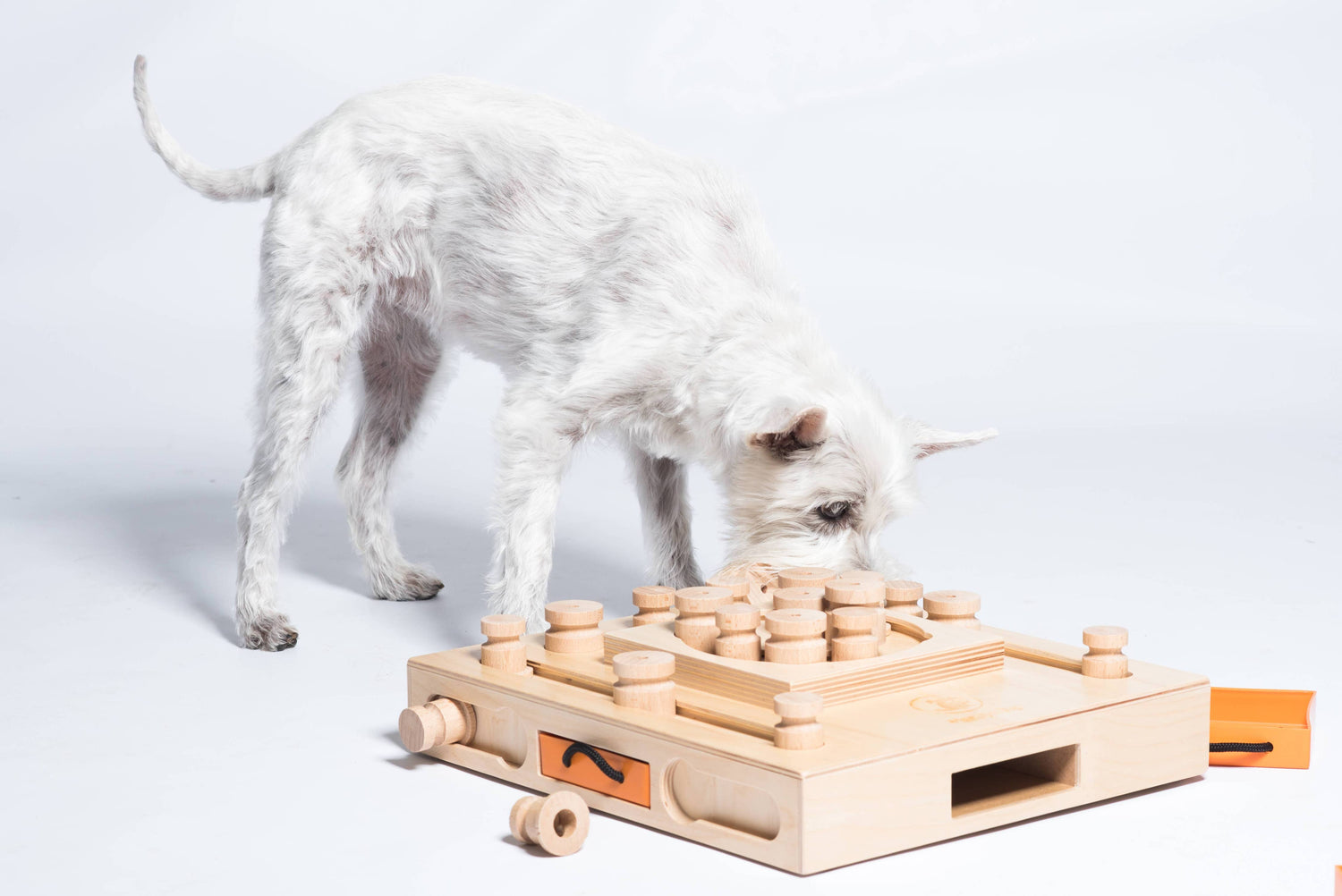
Supervised interactive puzzle feeders loaded with natural treats address the root cause of destructive behaviour directly. They give the Seeking System a legitimate, structured, safe outlet. The dog forages, problem-solves, earns a reward, and rests — the complete natural cycle that boredom-driven destruction is a distorted attempt to recreate.
We stock the My Intelligent Dogs wooden puzzle range for dog owners across Ireland — natural wood construction that holds treat scent beautifully, multiple difficulty levels from beginner to advanced, and built for genuine supervised daily use. These are not passive toys. They are enrichment tools that work best when you are actively involved alongside your dog throughout every session.
Every supervised interactive puzzle session is essential. Sit with your dog. Guide them through the puzzle. Celebrate each compartment solved. Step in immediately if frustration builds. Never leave your dog alone with a puzzle feeder or interactive toy. The goal is a positive, rewarding experience that your dog genuinely looks forward to.
Natural treats for supervised puzzle sessions: Beef Training Bites — Hot Dots (€5.70) (Beef Training Bites for maximum motivation at advanced levels), Venison Bites — Bambi Bites (€4.50) (Venison Bambi Bites for novelty and strong seeking drive), and Beef Meat Nuggets (€5.20) (Beef Meat Nuggets broken to puzzle size for Level 2 and Level 3 sessions). Browse all natural dog treats at Dogs-shop.ie.
The Variable Reward Loop: Why Puzzles Outcompete Furniture
Dopamine is most powerfully released in response to unpredictable reward. When a dog chews something they shouldn't, the experience varies — sometimes satisfying, sometimes producing a reaction from you, sometimes an interesting texture or sound. That unpredictability is deeply self-reinforcing — which is why destructive chewing escalates rather than diminishing if left unaddressed.
A supervised puzzle feeder with variably loaded compartments uses this same neurological mechanism productively. Which compartment has the natural treat today? The Seeking System gets its dopamine hit through the supervised puzzle session. Your furniture gets left alone.
A Proven Weekly Plan to Stop Destructive Behaviour
- 3–5 supervised interactive puzzle sessions weekly: 15–20 minutes each, quality natural treats, variably loaded compartments, owner present and engaged throughout
- Daily supervised nose work or scatter feeding: low setup cost, high cognitive return
- Regular walks maintained: outdoor sensory experience and socialisation are irreplaceable
- One training session weekly with natural treats: reinforces productive engagement with you
- Every session closed with a supervised natural long-lasting chew: for large dogs, Venison Skin (€4.95) (air-dried, high hardness). Always supervise chewing. The physical act satisfies a genuine need and teaches your dog that enrichment always ends with calm, settled rest.
Frequently Asked Questions
My dog gets plenty of exercise. Why is it still destroying things?
Physical exercise and mental stimulation are distinct needs. A walk gives physical exertion and outdoor sensory input but rarely challenges the problem-solving parts of the brain. A cognitively under-stimulated dog will redirect that restless mental energy into destructive activity regardless of exercise levels. Supervised interactive puzzle sessions with natural treats 3–5 times per week alongside regular walks typically resolves destruction in Irish homes within one to two weeks.
How do I know if my dog is destroying things from boredom versus anxiety?
Boredom-driven destruction occurs at any time, targets a variety of different objects, and reduces when supervised enrichment is increased consistently. Anxiety-driven destruction is more specific: it typically occurs only when the dog is alone, targets doors, windows, or exit points, and is accompanied by visible distress such as panting or vocalisation before it begins. If supervised enrichment does not improve the behaviour within two weeks, a vet or qualified behaviourist consultation is the right next step.
Will supervised puzzle sessions really stop my dog from chewing things?
For boredom-driven destruction, yes — consistently and measurably. The research on supervised food puzzle enrichment reducing destructive behaviour is clear and well-replicated. The key is genuine consistency: 3–5 supervised sessions per week with quality natural treats, at the right difficulty level for your dog. Occasional sessions produce occasional improvement. Daily supervised enrichment produces lasting change.
My dog destroys things even when I'm home. Isn't that something else?
No — this is still almost certainly boredom. Boredom is not the same as loneliness. A dog can be cognitively bored in a full house if their brain has nothing meaningful to engage with. Supervised interactive puzzle sessions with natural treats are the same proven fix. The Seeking System needs a legitimate, supervised outlet regardless of whether you are present or absent. We serve dog owners across Dublin, Kildare, Meath, Wicklow and all of Leinster from our Rathangan shop at Dogs-shop.ie, with fast nationwide delivery on all orders.
Scientific References
[1] Panksepp, J. (1998) — 'Affective Neuroscience: The Foundations of Human and Animal Emotions.' Oxford University Press, New York. Primary source for the Seeking System theory and its application to mammalian behaviour.
[2] Applied Animal Behaviour Science (2008) — Schipper, L.L. et al. 'The effect of feeding enrichment toys on the behaviour of kennelled dogs.' Applied Animal Behaviour Science, 114(1–2), 182–195.
[3] Neurobiology of Aging (2005) — Milgram, N.W. et al. 'Learning ability in aged beagle dogs is preserved by behavioural enrichment and dietary fortification.' Neurobiology of Aging, 26(1), 77–90.
[4] Journal of Veterinary Behaviour (2012) — Kogan, L. et al. 'The use of brain games in reducing anxiety in dogs: a pilot study.' Journal of Veterinary Behaviour, 7(5), 279–285.
[5] Behavioural Brain Research (1996) — Rosenzweig, M.R. & Bennett, E.L. 'Psychobiology of plasticity: effects of training and experience on brain and behaviour.' Behavioural Brain Research, 78(1), 57–65.