
Proven Ways to Keep Your Senior Dog Joyful and Sharp
Share
Getting older doesn't mean losing joy. Your senior dog's joints may be stiffer, their walks shorter, their sleep longer — but their brain still needs to be challenged, stimulated, and given something meaningful to do every day. And research increasingly shows that the older your dog gets, the more important that daily mental challenge becomes.
Most conversations around senior dog care focus on the physical: joint supplements, gentler exercise, softer beds. These all matter. But something equally important is consistently overlooked: the ageing brain needs exercise just as much as the ageing body. Supervised interactive dog toys loaded with natural treats are among the most effective and proven tools available for keeping an older dog genuinely joyful and cognitively sharp.
Canine Cognitive Dysfunction Syndrome — the canine equivalent of dementia — affects an estimated 28% of dogs aged 11–12 and over 68% of those aged 15–16. The most powerful intervention available is consistent, regular cognitive enrichment. Here's how to introduce it.
What Happens to an Ageing Dog's Brain
Research published in the Veterinary Journal and multiple companion studies has confirmed that the ageing canine brain undergoes structural changes similar to early-stage dementia: beta-amyloid deposits, reduced cerebral blood flow, oxidative damage, and neuronal loss in areas associated with memory and decision-making. Behaviourally, this presents as disorientation, disturbed sleep, reduced interaction with family, house training regression, and reduced responsiveness to previously established cues.
A landmark study by Milgram et al. (2005) found that dogs receiving regular supervised cognitive enrichment — including food puzzle tasks — maintained significantly better learning ability compared to unenriched control dogs of the same age.
Neurobiology of Aging (2005) — Milgram et al.
'Learning ability in aged beagle dogs is preserved by behavioural enrichment and dietary fortification.' Dogs receiving regular supervised cognitive enrichment maintained significantly better learning ability compared to unenriched control groups. The study concluded that consistent cognitive challenge is among the most effective available interventions for age-related cognitive decline in dogs.
Why Supervised Interactive Puzzle Toys Work So Well for Senior Dogs
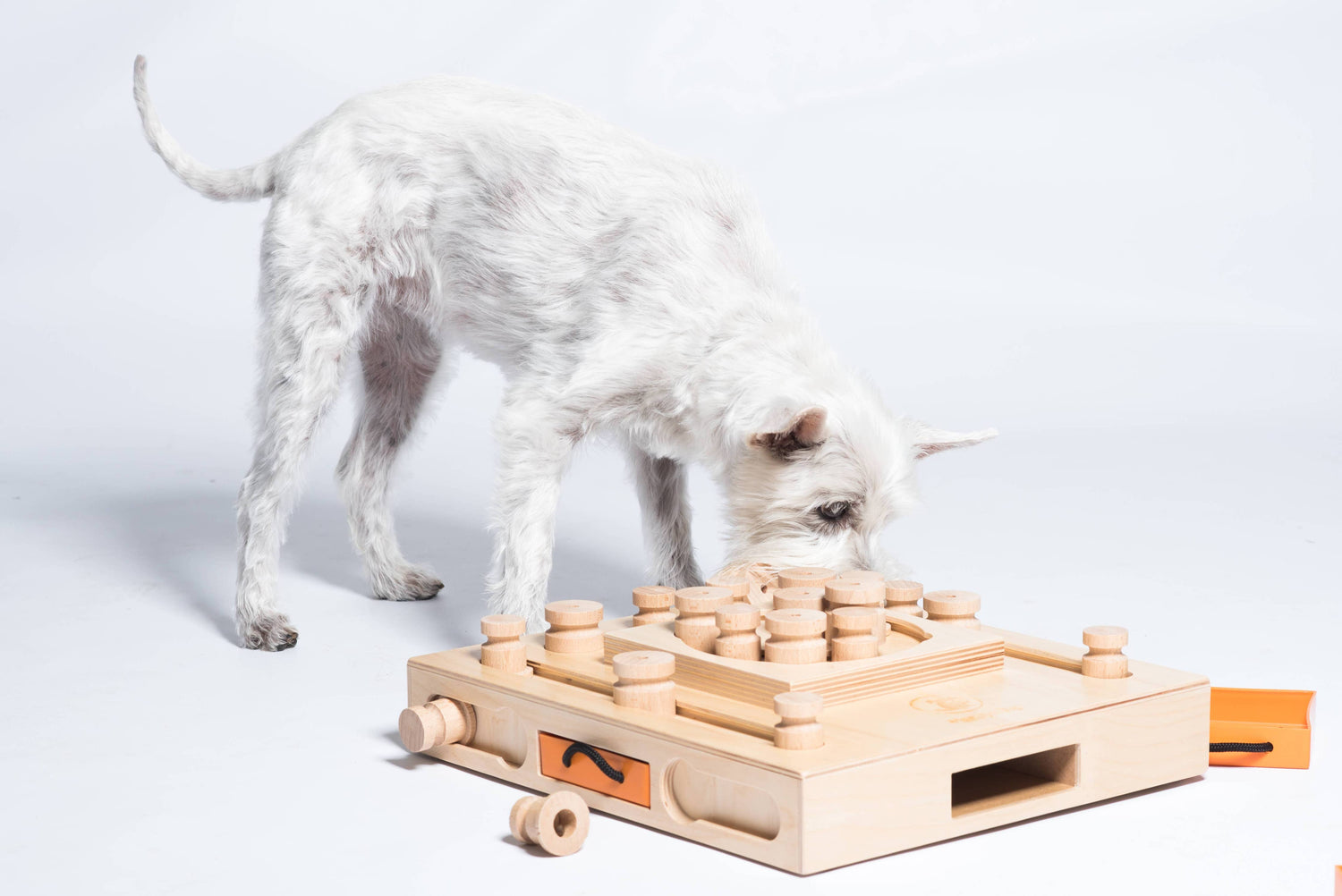
The particular value of supervised interactive puzzle feeders for older dogs is precision. A senior dog does not need to run, jump, or physically exert themselves to engage with a wooden puzzle feeder. They work at their own pace, sitting or lying comfortably, with you close by throughout the session.
All puzzle sessions for senior dogs must be supervised. Sit with your senior dog throughout every session. Senior dogs may frustrate or confuse more easily than younger dogs, and your calm presence is a core part of making the session positive and safe. Never leave an older dog alone with a puzzle feeder or interactive toy.
- Cognitive maintenance: Regular supervised problem-solving keeps synaptic connections active, engaging memory, pattern recognition, and persistence.
- Reduced anxiety: Many senior dogs experience increased anxiety as their world becomes less predictable. A daily supervised puzzle session provides reliable, positive structure.
- Better digestion: Working for food over 10–20 minutes distributes intake slowly and reduces bloating risk — a genuine benefit for older digestive systems.
- Maintained purpose: A dog with a daily job alongside their owner maintains better emotional regulation and shows less of the flat disengagement so common in under-stimulated elderly dogs.
Choosing Natural Treats for Senior Dog Puzzle Sessions
Senior dogs often have dental sensitivities, reduced digestive efficiency, and may need careful calorie management. The ideal natural treat for a senior dog's puzzle sessions must be:
- Gentle enough to eat without straining ageing teeth or jaw muscles
- Single-ingredient, animal origin — high digestibility with no additives to tax an ageing gut
- Aromatic enough to maintain motivation, since some senior dogs experience a gradual reduction in olfactory sensitivity
- Small enough for wooden puzzle compartments without requiring hard manipulation to extract
Proven natural treats for senior dog puzzle sessions: Hot-Air Dried Lamb Chunks — Merino Chunks (€4.50) (hot-air dried lamb, broken smaller, gentle texture kind to older teeth), Air-Dried Turkey Chunks (€4.50) (broken small — digestible, soft, aromatic), and Rabbit Bites — Bunny Bites (€4.50) (single-ingredient rabbit, particularly gentle on older digestive systems). All available at Dogs-shop.ie.
For the calm-down chew after every supervised session, Iberian Pork Pizzle (€3.95) (medium-low hardness) is ideal for small and medium senior dogs with good dental health. Always supervise chewing, particularly for older dogs whose dental strength may have changed.
Getting the Difficulty Level Right
Always start lower than you think necessary. If your senior dog has never used an interactive toy before, begin at the easiest difficulty level regardless of how sharp they seem mentally. The goal for older dogs is not progression through levels — it is consistent, positive, daily supervised cognitive engagement.
Signs the level is right during a supervised session:
- Engages with the puzzle feeder within the first minute
- Completes the session without visible frustration or confusion
- Appears settled and satisfied after the session rather than agitated
- Approaches the next supervised session willingly and with anticipation
How to Introduce a Senior Dog to Puzzle Feeders
- Supervised Session 1: Load all compartments with natural treats and leave them completely open. Sit with your dog and let them eat freely from the toy. The goal is purely positive familiarity with the object and the concept.
- Supervised Sessions 2–3: Close compartments very lightly. Stay close, encourage verbally, guide gently when stuck. Do not allow frustration to develop at any point.
- Supervised Sessions 4+: Begin increasing compartment resistance gradually. Remain nearby and supportive. Allow independent problem-solving to develop at your senior dog's own pace.
A senior dog who builds a confident, joyful relationship with supervised puzzle enrichment has a tool that will genuinely support their quality of life for years to come.
Frequently Asked Questions
At what age is a dog considered senior in Ireland?
Large and giant breeds are generally senior from around 6–7 years. Medium breeds from around 8–9 years, and small breeds from 10–12 years. If your dog has been diagnosed with age-related conditions such as arthritis, reduced vision, or cognitive changes, adapting their enrichment and beginning supervised puzzle sessions is appropriate regardless of exact age.
My old dog has never shown interest in toys. Is it too late to start?
It is never too late. Most older dogs who haven't encountered interactive toys simply don't yet understand what they are. Sit with your dog for the first several supervised sessions, load all compartments openly, and let them eat freely from the toy. Once they associate the object with finding natural treats, interest develops quickly. Your calm presence and encouragement are the most important ingredients.
Should I always supervise my senior dog during puzzle sessions?
Yes, always — and especially for senior dogs. Older dogs may confuse or frustrate more easily than younger dogs, and your calm presence makes every session safer, more positive, and more effective. Supervision also lets you notice any changes in engagement or behaviour over time. Never leave a senior dog alone with an interactive toy or feeder.
How often should a senior dog do supervised enrichment sessions?
Three to five supervised sessions per week is a well-supported target. Daily is ideal if your dog engages willingly and ends sessions settled rather than fatigued. Sessions should always be short enough that your senior dog finishes with energy to spare — a dog who ends a puzzle session visibly exhausted is a signal that the difficulty is too high or the session too long. No matter where you are in Ireland — Dublin, Cork, Galway, Limerick, Waterford, Kilkenny, Sligo, Drogheda, Naas, Navan, Ennis, Tralee or anywhere else — we deliver from our Rathangan shop at Dogs-shop.ie. Fast nationwide delivery on every order.
Scientific References
[1] Neurobiology of Aging (2005) — Milgram, N.W. et al. 'Learning ability in aged beagle dogs is preserved by behavioural enrichment and dietary fortification.' Neurobiology of Aging, 26(1), 77–90.
[2] Neurobiology of Aging (1996) — Cummings, B.J. et al. 'The canine as an animal model of human aging and dementia.' Neurobiology of Aging, 17(2), 259–268.
[3] Journal of the American Veterinary Medical Association (2001) — Neilson, J.C. et al. 'Prevalence of behavioural changes associated with age-related cognitive impairment in dogs.' JAVMA, 218(11), 1787–1791.