
Stop Wasting Money on the Wrong Dog Toy
Share
You bought the toy. You presented it to your dog with quiet pride. Your dog sniffed it once, walked away, and has not looked at it since. If that sounds familiar, you are not alone. The Irish pet toy market is full of products that look impressive and deliver almost nothing in terms of lasting engagement.
The problem is almost never the concept of the toy — it is the failure to match the toy to the dog, the difficulty to the dog's current ability, and the natural treat to the toy's demands. Here is how to stop wasting money on dog toys that get ignored — and start investing in supervised interactive dog toys that genuinely work.
Why Most Dog Toys Fail Within 48 Hours
Most dog toys are passive: the dog chews, chases, or squeaks them. These toys deliver stimulation, but not enrichment. The distinction matters enormously. Stimulation is any input. Enrichment is cognitively meaningful input that requires your dog to think, try, fail, and try again. Dogs habituate to passive toys very quickly. They thrive on novel problem-solving.
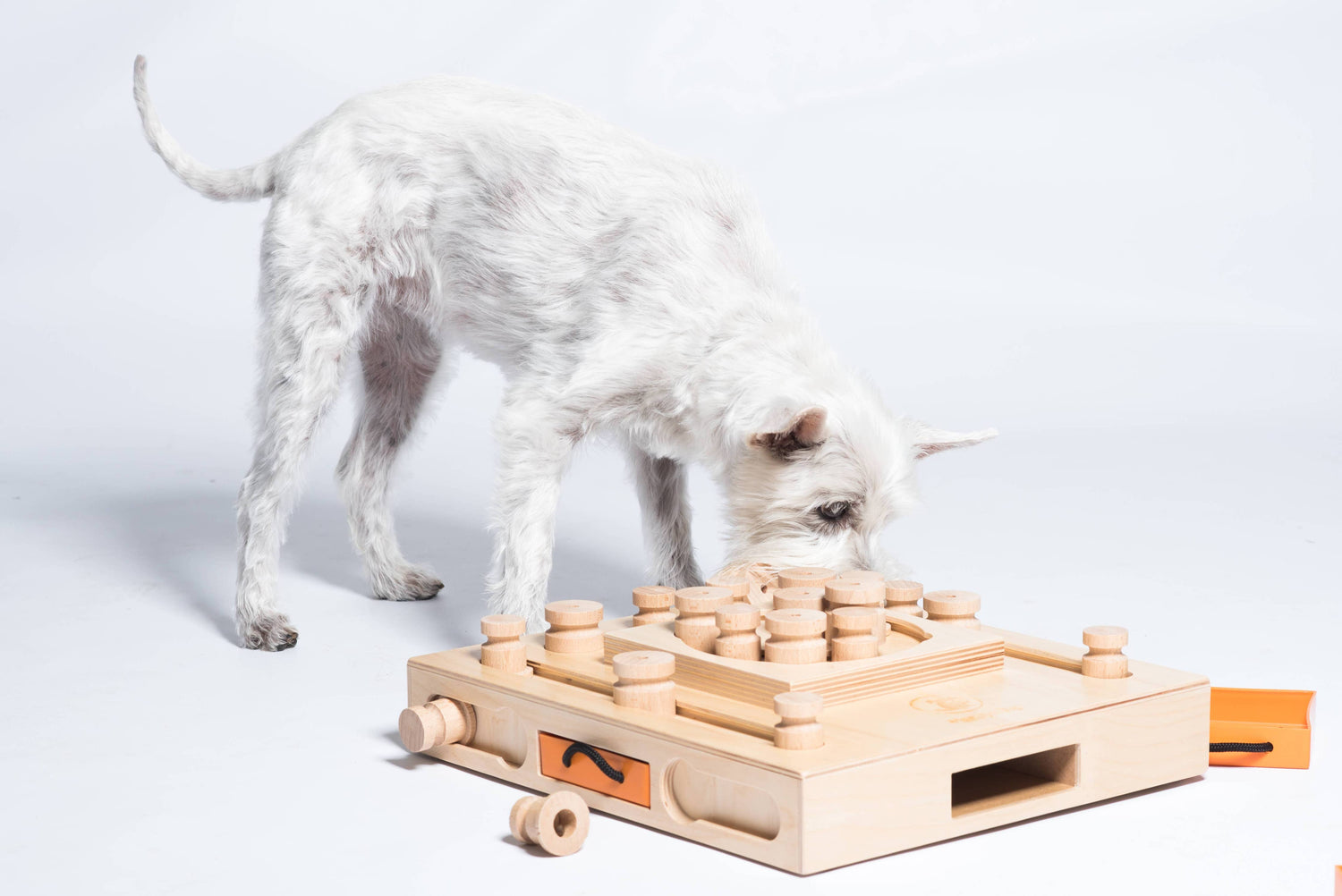
Interactive dog toys — specifically, wooden puzzle feeders loaded with natural treats — are different because the reward is unpredictable. Which compartment has the treat? Which mechanism reveals the food? That uncertainty produces sustained dopaminergic motivation that passive toys simply cannot match.
The Interactive Dog Toy That Consistently Works: Wooden Puzzle Feeders
For dog owners across Ireland, the most consistently effective interactive dog toy is the My Intelligent Dogs wooden puzzle feeder range. Solid wood construction that holds natural treat scent beautifully. Multiple difficulty levels from complete beginner to genuinely advanced. Built to withstand real supervised daily use. And — critically — designed to grow with your dog's developing problem-solving ability.
Every interactive dog toy session must be supervised. Sit with your dog throughout. Guide them when they get stuck. Offer encouragement. Step in if frustration builds. Never leave your dog unsupervised with a puzzle feeder or any interactive toy. A supervised session is safer, more effective, and builds a positive association with the toy that makes every subsequent session better.
The Key to Success: Matching Difficulty to Your Dog
Beginner Level — The Right Start for Any Dog
No previous puzzle experience, a puppy, or an anxious dog. At this level the goal is not challenge — it is a first successful, positive experience with an interactive toy. Fill every compartment. Let your dog experience finding food before introducing the challenge of working for it. Celebrate every success verbally during the supervised session.
Best beginner natural treats: Hot-Air Dried Lamb Chunks — Merino Chunks (€4.50) (broken smaller, gentle texture, compelling warm aroma) or Rabbit Bites — Bunny Bites (€4.50) (single-ingredient rabbit, novel protein, immediately appealing to most dogs). Available at Dogs-shop.ie.
Intermediate Level — Building Real Cognitive Challenge
Your dog completes beginner puzzles confidently. They work through the interactive toy methodically, trying different approaches when a compartment resists. Begin varying which compartments you fill each session. Unpredictability maintains the seeking drive and prevents your dog from relying on pattern memory rather than genuine problem-solving.
Best intermediate natural treats: Salmon & Lamb Bites — Buzzy Snack (€3.00) (small, excellent fish-forward scent) or Venison Bites — Bambi Bites (€4.50) (soft novel protein, easily broken to compartment size).
Advanced Level — For Dogs Who Have Earned It
Your dog solves intermediate puzzles calmly and shows the quiet concentration of a dog in genuine working flow. Reserve your highest-value natural treat for the hardest compartment specifically. Graduated reward teaches graduated effort — the biggest payoff for the biggest challenge.
Best advanced natural treats: Beef Training Bites — Hot Dots (€5.70) (the treat your dog will work hardest to reach) or Beef Meat Nuggets (€5.20) (broken to puzzle size — dense, aromatic, genuinely high-value reward).
How to Know When to Move Up a Level
Before promoting your dog to the next difficulty, all four of these must be consistently true across multiple supervised sessions:
- Engages immediately every session without any prompting
- No frustration or disengagement at any point during supervision
- Returns enthusiastically to the next supervised session
- Tries different approaches when a compartment resists rather than repeating the same motion
Once all four are reliably true, move up one level and temporarily increase natural treat value to compensate for the added mechanical challenge. Always let treat value rise when difficulty rises.
Special Considerations for Different Dogs
Puppies
Always start at the easiest level, with very short supervised sessions of 5–10 minutes maximum. Puppies need to learn what a puzzle is before they can learn how to solve one. Hot-Air Dried Lamb Chunks — Merino Chunks (€4.50) broken small are ideal — gentle on puppy teeth and aromatic enough to hold wandering puppy attention.
Senior Dogs
Stay at whichever level delivers consistent success. The cognitive benefit is identical at Level 1 as at Level 3. Air-Dried Turkey Chunks (€4.50) (broken small) are gentle on older teeth, easily digestible, and aromatic enough to motivate even dogs with slightly reduced olfactory sensitivity.
Anxious Dogs
Supervision is especially critical for anxious dogs. An anxious dog who experiences puzzle frustration without you there to help may form a lasting negative association with interactive toys entirely. Sit close, speak calmly, reduce difficulty or end the session positively at the first sign of stress.
Frequently Asked Questions
Do I need to supervise my dog with puzzle toys?
Yes, every time. Every interactive dog toy session must be fully supervised. Sit with your dog, offer verbal encouragement, guide them when they get stuck, and step in immediately if frustration builds. Supervision makes every session safer and dramatically more effective. Never leave your dog alone with a puzzle feeder or interactive toy.
How long should a supervised puzzle session last?
A single puzzle attempt should take between 3 and 8 minutes at a well-matched difficulty level. Under 2 minutes means the puzzle is too easy or too heavily loaded. If your dog gives up before finishing, the difficulty is too high or the natural treat value too low. A full supervised enrichment session might include two or three attempts with short breaks, totalling 15–20 minutes.
My dog flips the puzzle over instead of solving it. What do I do?
This is exactly why supervision matters. During the supervised session, gently reposition the puzzle, guide your dog's nose toward a compartment, and praise any correct interaction. For the first few sessions, load all compartments and leave them completely open so your dog learns that engaging with the toy — not flipping it — is what produces the natural treat reward.
Are wooden puzzle toys better than plastic ones?
Wooden puzzle feeders hold natural treat scent significantly better than plastic, which makes them more motivating for nose-led dogs during supervised sessions. They have a more satisfying tactile quality and are more durable under genuine daily supervised use. For dry, single-ingredient natural treats, wooden puzzles consistently produce higher sustained engagement. We serve dog owners across Dublin, Kildare, Meath, Wicklow and all of Leinster from our Rathangan shop at Dogs-shop.ie, with fast nationwide delivery on all orders.
Scientific References
[1] Applied Animal Behaviour Science (2004) — Schipper, L.L. et al. Study examining the effect of feeding enrichment toys on kennelled dogs, finding significant increases in engaged behaviours and reductions in passive, repetitive patterns.
[2] Journal of the Experimental Analysis of Behaviour (2008) — Udell, M.A.R. & Wynne, C.D.L. 'A review of domestic dogs' (Canis lupus familiaris) human-like behaviours.' Examining problem-solving cognition and learning in domestic dogs.
[3] Neurobiology of Aging (2005) — Milgram, N.W. et al. 'Learning ability in aged beagle dogs is preserved by behavioural enrichment and dietary fortification.' Neurobiology of Aging, 26(1), 77–90.